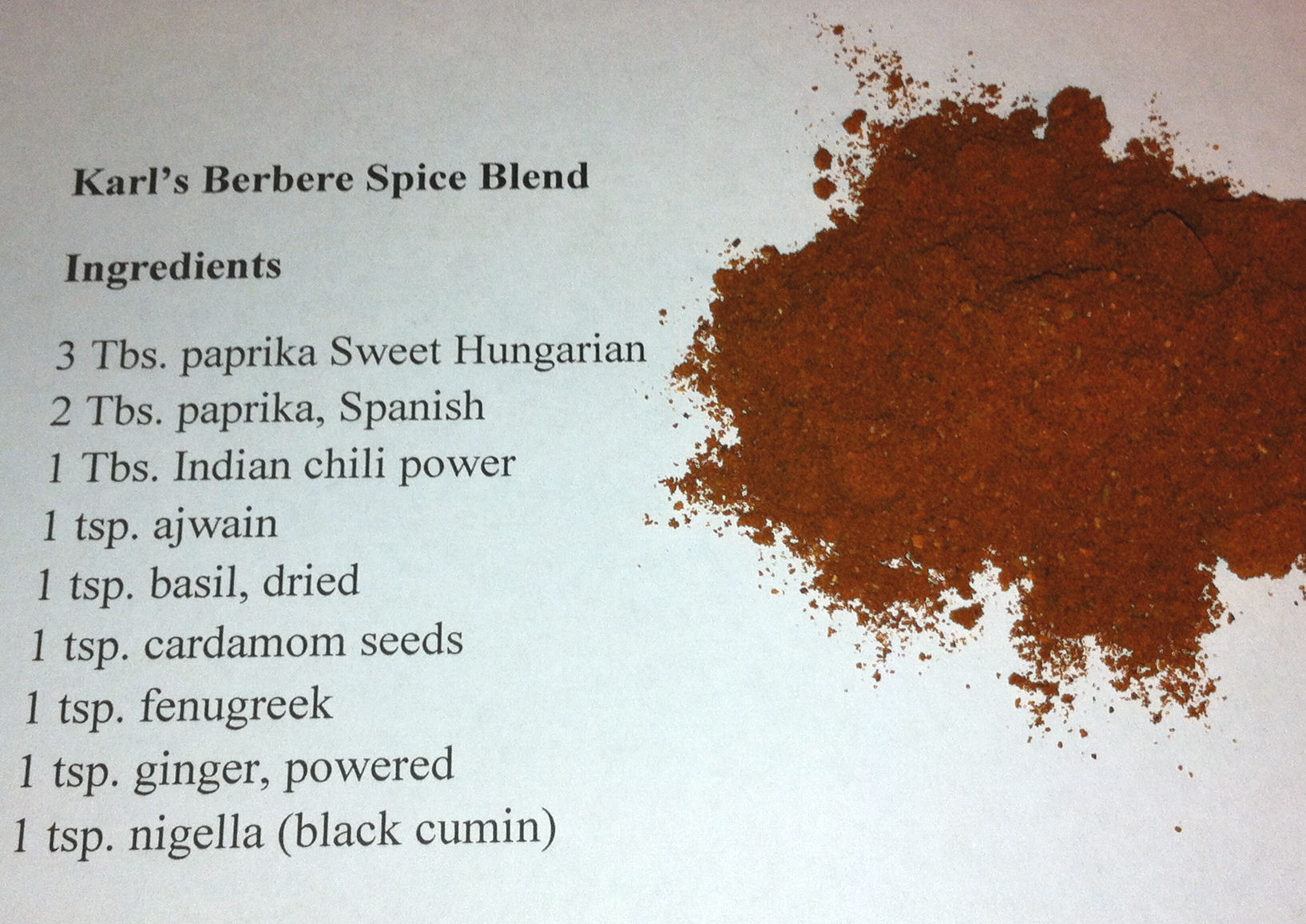
The spice blend Berbere (when the Ethiopians say it, it sounds like “Barbara”) seems to define the Ethiopian stew called wat. According to Wikipedia Berbere contains: chili peppers, garlic, ginger, dried basil, korarima, rue, ajwain or radhuni, nigella, and fenugreek. A couple of these spices are hard to acquire outside of Africa.
Tag Archives: Philosophy of Cooking
Karl’s Moroccan Oxtail Tajine
Adapted from a recipe by Mamatkamal El Mary K
This week is Chris’ Birthday. Myr is taking him out for steak on Saturday, so she wants something heavy on the vegetables. Jan really liked the Chicken Cassablanca I made last week, so she wants a North African tajine (tu-jeen). I have some French green lentils that I have wanted to try out (A Taste of History idea). Chris (who just landed from a trip to Germany) got in the last word, he wants oxtails. This I can work with.
Filed under Beef, Main Dishes, Stews
Karl’s Uyghur Lamb Samsa (Baked Samosa)
This recipe comes from a memory of a taste and of a Mongolian? Chef (from the banner behind him I think it is Inner Mongolia).
Yesterday I made Uzbek samsa, a baked dough filled with spinach, and it reminded Jan of the Uyghur lamb samsa we had in Kashgar in 1988. I know the name Uyghur looks frightening to American sensibilities, but it is pronounced “Way-ger.” We were taking our vacation, from teaching English to the Chinese, to the far west of China. There were almost no foreigners in China during those months so, except for a few stray Canadians and Australians, we had Xinjiang pretty much to ourselves (not counting several million locals). The locals assumed that we were Canadians, except for the one who thought I was a Russian and the woman who came up to Jan and started chatting her up in Uyghur. She could have easily passed in the Mexican embroidered dress and the Russian babushka she was wearing.
Filed under Lamb, Main Dishes
Karl’s Twice Cooked Pork
Adapted from CHICHI’S CHINESE
When we lived in Chengdu, Sichuan, this was one of my favorite dishes. My Chinese friends would ask, “Why do you want to order THAT? It’s a peasant’s dish!” One of my first culture shocks in China was when one of my students proudly announced, “My father was a peasant. My mother was a peasant. I am a worker.” Because there are no peasants in America, we tend to forget that many other countries still have them.
One thing that I have learned since that time is that it is not just twice cooked pork that I like, but the way that dish was prepared by the old cook at the Panda House Restaurant. Many of the recipes that I have found, since I came back from China, call for fatty pork belly and cabbage. The cook at the Panda House used a very lean cut of pork and lots of green onions. The other recipes are nice, but his was spectacular.
Filed under Main Dishes, Pork
Karl’s Greek Lamb Stew
I like to have lamb for my birthday, preferably Greek Barbequed Lamb. Tuesday is my “Big 6-0,” so I really wanted something with lamb. There is a Winter Spare the Air Alert for San Jose, so BBQ was not possible. I decided to do a lamb stew instead, Greek of course. I looked at many “Greek Lamb Stew” recipes on-line, and while many of them seemed good, I thought I could do better.
Filed under Lamb, Main Dishes, Stews
Karl’s Basque Chicken in a Clay Pot II
This recipe started out as one of the challenges that Myr wrote about when she set up this blog. The Sunday before this dinner one word was announced at the dinner table, “Basque.” While I have been to Basque restaurants and I knew that I liked the food, I had never attempted to make any Basque dishes before. This is my idea of a good time, searching the Internet for a cuisine that I have never tried and knew little about.
What makes a dish “Basque?” The Basques live in the area of southwestern France and across the border in Spain. Continue reading
Filed under Clay Pots, Main Dishes, Poultry, Techniques
Dedicated to my mother, Claudia, the first great cook.
Myr has finally dragged me, kicking and screaming, to start posting my recipes on-line.
A bit of family history and cooking philosophy is perhaps in order so any gentle readers will understand where I am coming from.
My mother was a middle child in a large family. As a result, the older sisters did all of the cooking and my mother never learned “family home cooking” in her mother’s style. She liked to say that when she married my father she “could only boil an egg and make French Onion Soup.” Starting from scratch, as it were, she experimented with a variety of cuisines, frequently influenced by my father’s travels to Japan and Europe. Dad would return with tales of foods he had eaten and she would attempt to replicate the dishes with the ingredients available at the time (the 1950s to 1960s). At a time when most Americans were eating hot dogs, meatloaf and mashed potatoes, she served us Pizza , Chicken Teriyaki, and hot German Potato Salad (long before these became standard American foods).
My mother taught me her style of experimental cooking and I ran with it. When I was working in the North Sea, I paid attention to what the Spanish cooks were making for dinner. The same was true when I traveled in Europe and when we lived in Chengdu and Hong Kong. I picked up cook books the way many people pick up novels. It became a challenge to find cuisines I had not experimented with, but I was experienced enough now that I could rarely make any dish exactly as written. I always had to tinker, particularly when my wife’s health required an extremely low fat diet.
What makes a dish a particular dish?
Five recipes might have the same name but have only a few main ingredients in common. I learned to read and compare recipes and select the elements that I felt should make the dish. I might take ingredients from some of the recipes and cooking techniques from the others and come up with something unique and my own. I realized recently that this is the same technique used by the “Cook’s Illustrated” staff in creating their recipes. (I am a faithful reader by the way, but I have serious issues with some of their base ecological and culinary assumptions.) Sometimes this process would produce spectacular culinary disasters, but more often than not my dishes were successful.
Myr has convinced me to begin posting my journey on this blog from time to time.
Filed under Other